Mersive Q1 2023🐣- Q2 2024 🪦
The Mersive Story Part 1-
B2C Product and Idea in 2023
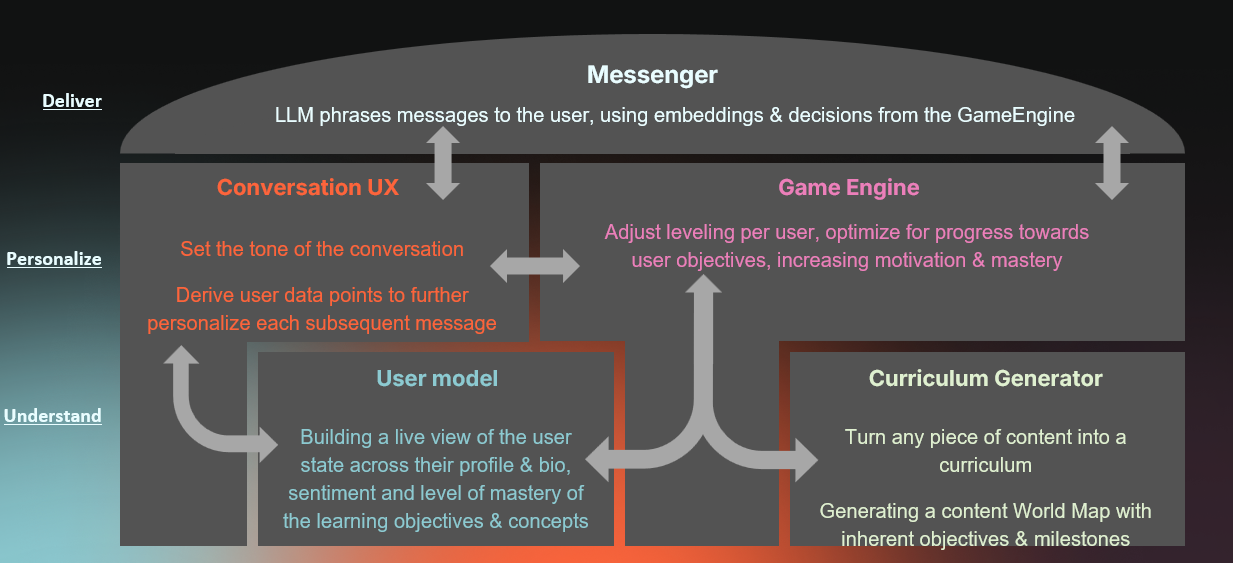
Mersive V1 was conceived as a platform to transform the world's best content into fully personalized, interactive, and persistent conversations using AI messaging.
Gemini summary of Mersive in 2023 from emails in my inbox from that year:
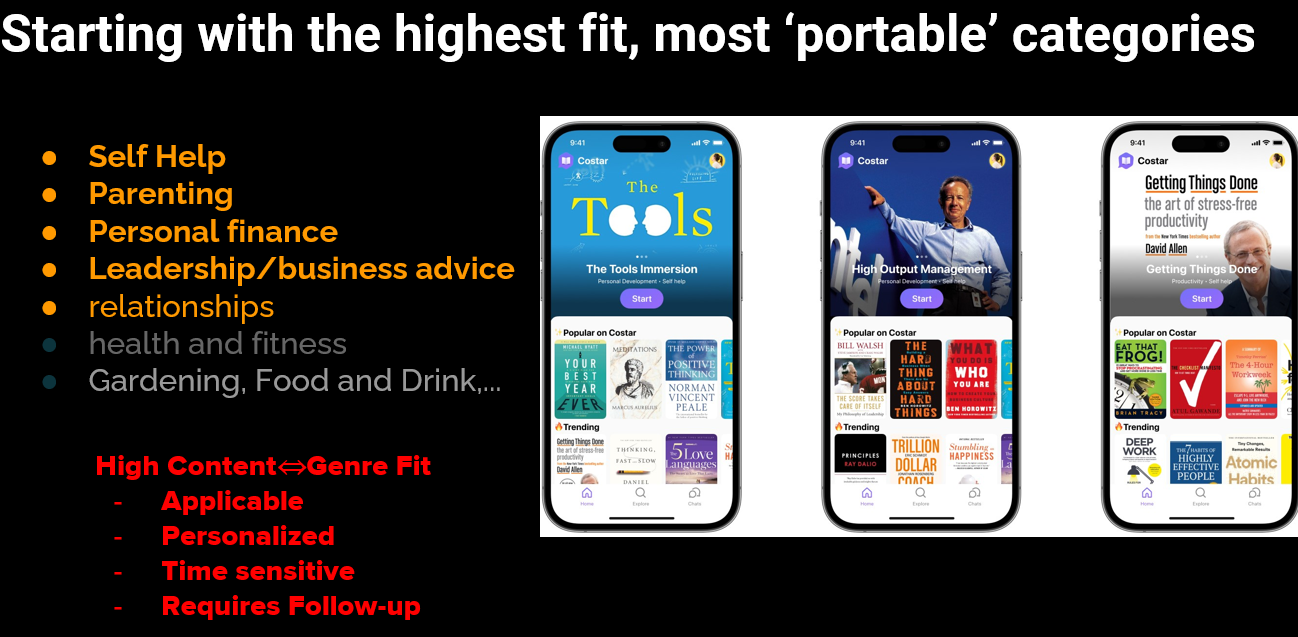
The initial market entry focused on the personal development category.
The core functionality was modeled as a personal coach based on a user's favorite book or topic.
The AI-guide's role was to proactively reach out, navigate the user through the content, and support the implementation of lessons.
The coaching experience would adjust specifically to the user's tone, life rhythm, objectives, bandwidth, and craft immersion objectives and progress accordingly.
Examples of personal development topics included Stoicism or "Getting Things Done".
The conversations were primarily designed to happen natively within iMessage and WhatsApp for most users, with a dedicated app for power users.
The technology stack incorporated Large Language Models (LLMs) for some components.
A plan was in place to build custom "game engines" to handle critical functions like tone, timing, and other decisions based on the user, content, and real-world context.
The product drew explicit similarities to gaming, especially in how the AI-guide learns, adjusts its approach, measures progress ("leveling"), and creates engaging elements like discovery, surprise, achievement, and connection.
The long-term vision involved expanding the content categories beyond personal development to include areas like history, biographies, and science fiction.
Future experiences were planned to be multi-user, social, and infinitely deep, centering around the user’s profound passions.
The Product v0.1: Creating a personal coach
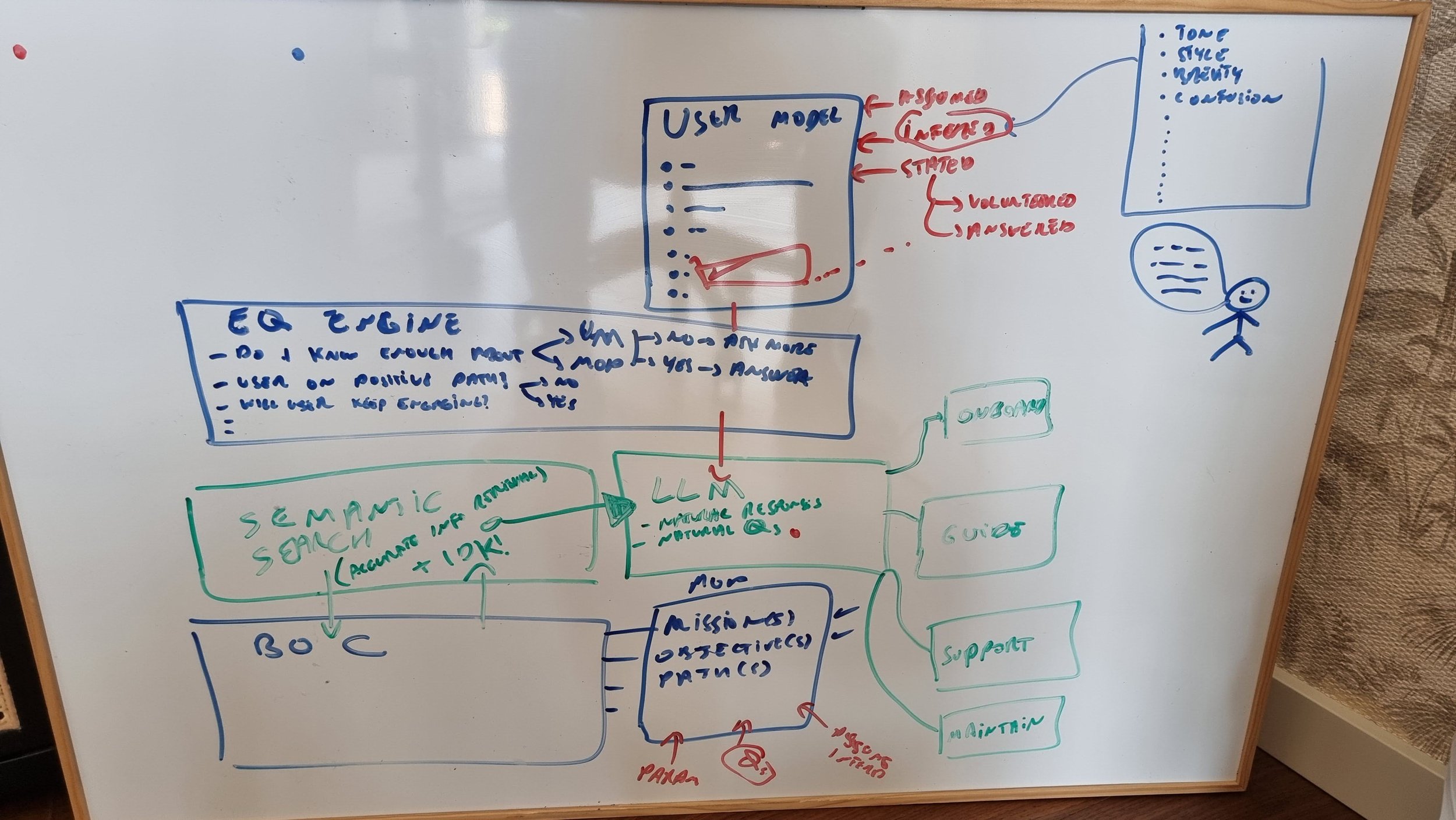
This is a whiteboard from early 2023 showing the components of the product at a high level:
Body of content [BOC]: this is the book/compilation of articles/podcast or other content that the user picks as right for them.
From the BOC we extract what a general MOP is:
Mission the overall north star that the BOC is pointing you towards.(might be becoming a better parent, a better leader, or any end goal you want to adopt)
Objectives: the specific goals you want to achieve (leader example: do better 1-1s, give clear feedback, speak more clearly, etc etc)
Path: the sub-milestones to hit on your way towards achieving those objectives
This becomes similar to a real world or game map of the landscape of the BOC, you can navigate it in any dimensions. Sometimes there are constraints like sequencing, a milestone has to be achieved before proceeding to a next stage. So there’s a balance between freedom of “movement” and BOC derived constraints (dependencies/gating items etc)
BOC is queried through semantic search to answer use chats/questions or “I don’t know”
User model: This is the collection of data points (Qual and Quant) that we have about the user and use to help them.
There’s a minimum viable amount of info we can go with and we keep enriching it as we go, no intense long onboarding as it creates a bad first impression and makes the convo mechanistic.Assumed: start with some assumptions then check them
volunteered: things the user mentions during onboarding or
Answered: specific essential information/context: we just ask the user for them.
The User model is ALWAYS updated, every interaction updates it:
New info from user
User response time/speed
Tone
And Deltas between all these things in different contexts.
EQ engine: This is a fancy name for a set of logic and heuristics that takes as the input the next milestone the user needs to achieve, the user state, the general context and creates the custom prompts that feed to the llm to handle the conversation to approach the next milestone. I believe In the gaming world it is called a quest system or mission planner.
Coaching Styles and frameworks
Coaching Frameworks
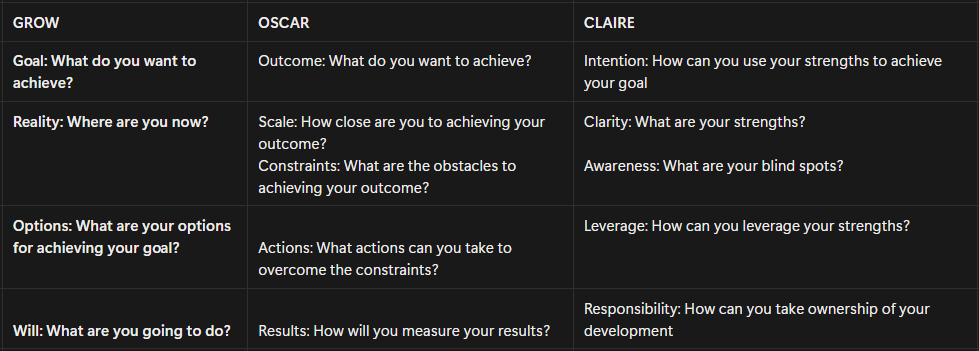
Did a bit of research about the methodologies the coaching world uses, learned a bit more about the GROW, OSCAR. CLAIRE frameworks.
They all basically boil down to:
Know current reality, understand the delta between reality and Goal and Work on closing that delta.
Coach Values
Integrity: I keep my commitments, and take responsibility for my actions.
Honesty, make intentions clear
Commitment to client’s success
Empathetic/Understanding
Adaptability
Gemini summary for 2023 emails about some of the key features of the product:
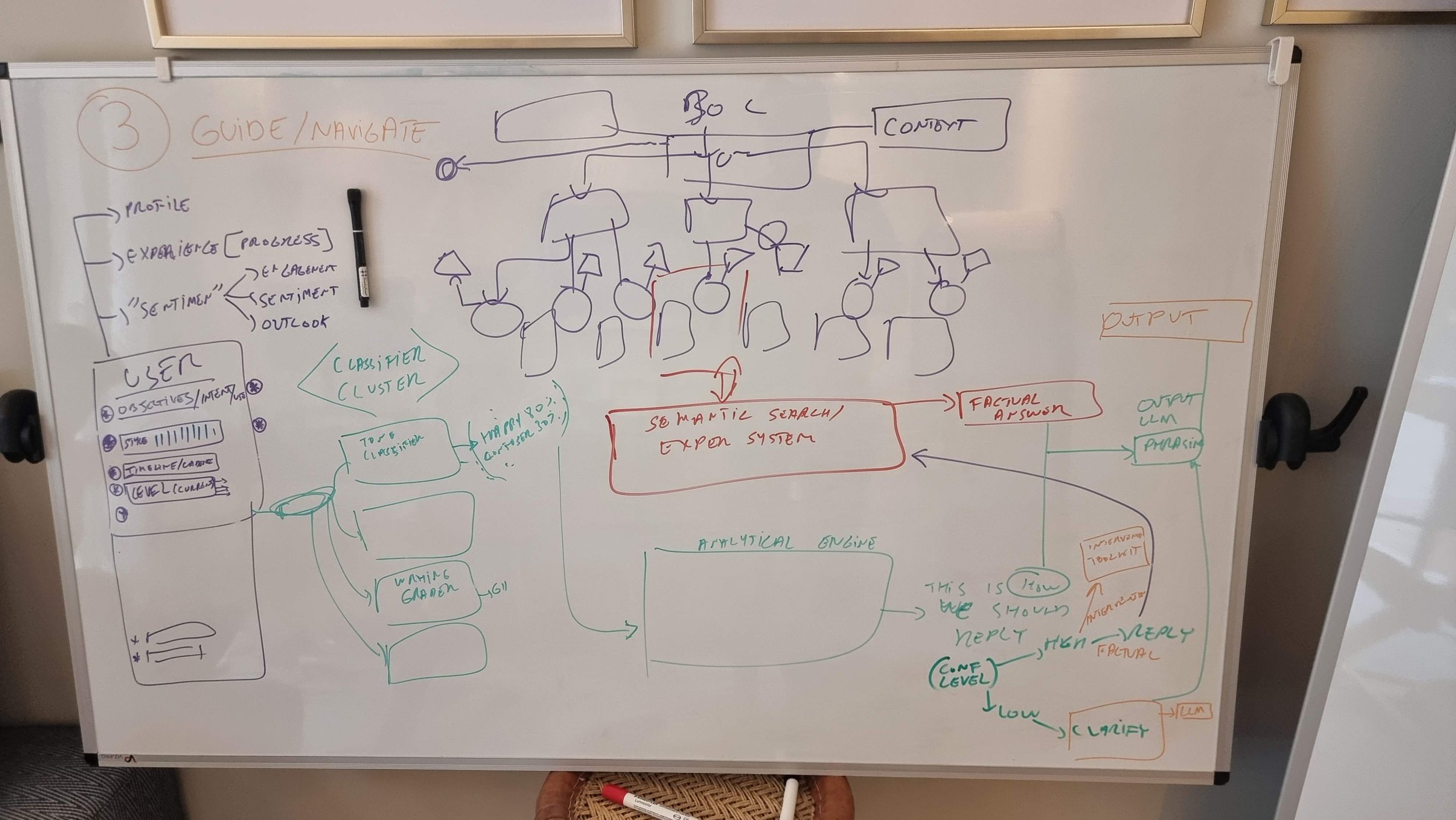
The success of the Mersive product in 2023 was primarily dependent on establishing a sophisticated Mersive Logic Layer—the "middle layer"—which was designed to dynamically personalize the coaching experience.
The different components to make the product successful included:Core Logic and Architecture Components
The Mersive Logic Layer: This was the central processing unit, described as the "middle layer," that connected the user experience to the underlying content and models.
User Prompt Staging: A mechanism to hold the user's input for up to 20 seconds to combine multiple messages before classification and processing.
User Prompt Classification LLM Apps: Used a Classification LLM to categorize the user's prompt based on dimensions like tone and length.
Prompt Engineering Engine: The component responsible for dynamically generating the final prompt sent to the content model. It concatenated multiple inputs to ensure personalization. The combined inputs included:
The user's previous conversation history.
The classification details (tone and length).
Pre-set safeguard rules.
Few-shot examples specific to the book or experience.
The Author Bio and AI-guide Bio.
This dynamic assembly was designed to create a high number of variations (e.g., 288) based on reading the "user state".
Book Generation LLM App: The model (e.g., Davinci Model) responsible for generating the core content response for a specific book.
Completion Response Final Checks (Safeguard Engine): An LLM-based check to ensure the generated response adhered to a set of rules, such as not including negative comments about the author or discrimination.
Gamification Engine: Logic to check user history, prompt, and response to add gamified features, such as sending an audio voice note if the response was over 90 words.
Conversational and Pedagogical Components
Conversational Building Blocks ("Leafs"): These were defined as specific units that deliver a "pedagogical payload" in a few text messages.
Topic Dependencies: A conceptual feature to set minimum "requirements" that needed to be met before a new content topic (or "leaf") could be proposed, ensuring the user was ready for the next step.
Progression Logic: Simple logic was being developed to measure two main user axes to manage conversation flow:
Sentiment/Engagement/Motivation
Mastery/Confusion
This logic was intended to decide when to move from one "leaf" to the next, when a topic was fully covered, or when user engagement was low.
"Lubrication" Conversation: Content intended to be inserted between "leafs" to prevent the conversation from becoming too "dry" by prompting reflection, adding humor, or sharing interesting information.
Focus on Quick Value and Personalization: A core priority identified in mid-2023 was the need for quick to value, quick to personalization. This involved prioritizing the extraction of practical tips and knowledge nuggets for immediate user needs (e.g., the top three tips for a performance review) over a rigid, academic curriculum to overcome user skepticism and frustration.